West Craven High School
ASPIRE
English
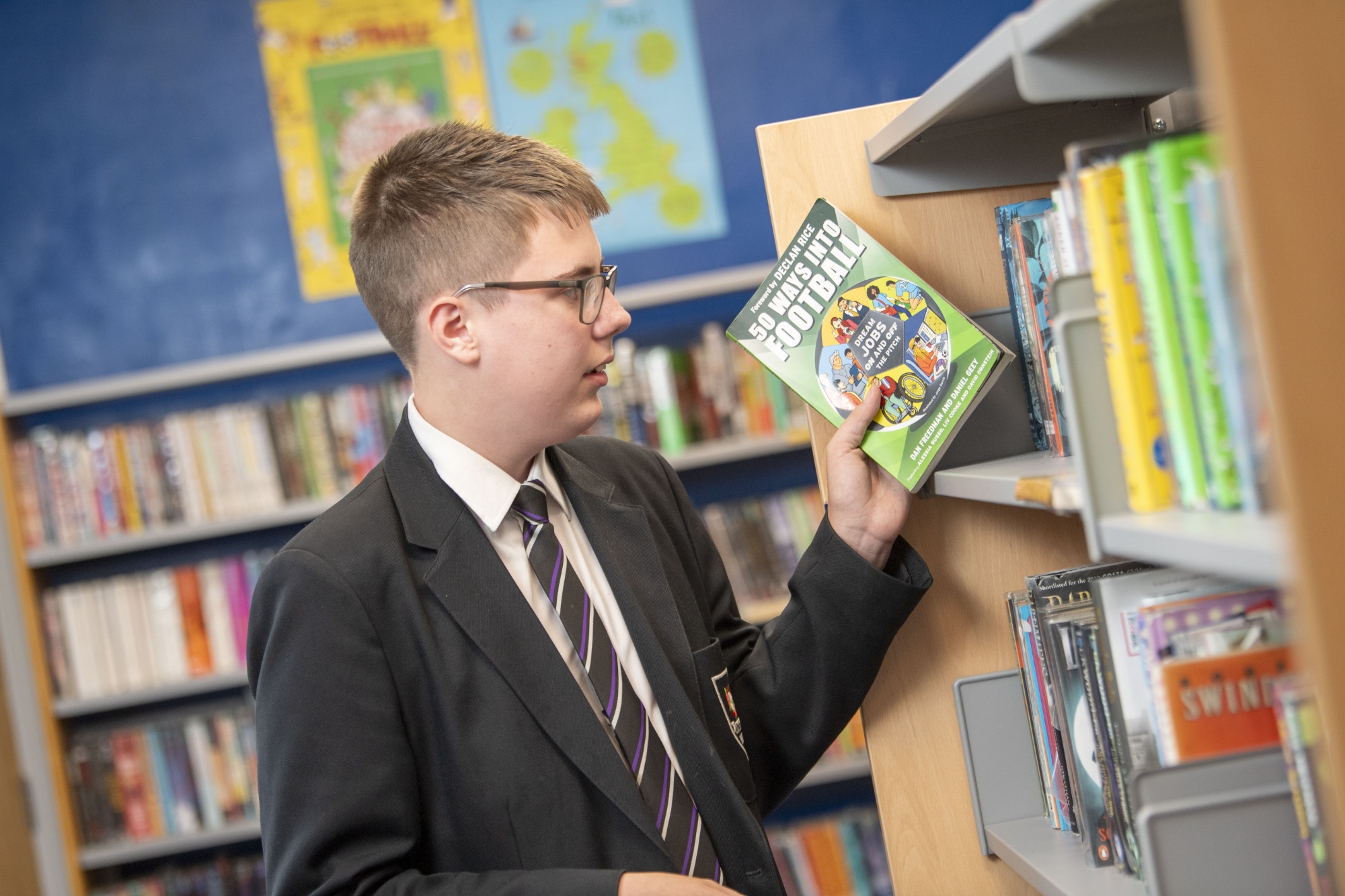
In English, we aim to provide all our students with a diverse and intellectually challenging curriculum that reflects upon both local and global communities. We encourage our students to be pro-active learners, nurturing their confidence so that they are willing to challenge themselves, working both independently and collaboratively, to realise their potential.
In engaging our students with experiences beyond their own, as well as experiences that may resonate with them, we aim to develop their skills as effective communicators, critical readers, analytical thinkers and original, creative writers. It is a curriculum with strong cross-curricular and extra-curricular links which equips them well for their next steps, either in higher education or future employment.
At Key Stage 3, our students follow the National Curriculum. We aim to instil a love of reading through developing vocabularies and skills through explicit teaching. We encourage our students to find their own voice in writing while enjoying literature from our literary heritage as well as from other cultures and traditions. They have the opportunity to participate in a diverse range of activities. Our students learn to talk, to read and write as experts, to develop informed opinions, reasonable argument and critical analyses as well as writing imaginatively, and remembering the emphasis we can create through the dash – or a rat lurking in separate!
We expect the very best from all our students, building on the skills taught from Key Stage 3 through to GCSE, where they follow the AQA programmes of study in both English Language and English Literature. Their learning is underpinned by reading between the lines and interpreting texts, writing with increasing clarity, coherence and cohesion, and speaking with increasing fluency and flair.
Our team of English specialists are committed to providing the best quality teaching and learning of our students. We work collaboratively, drawing on a range of expertise, skills and knowledge to develop excellent resources to engage and enthuse our students.
Year 7
In the Autumn term, students develop their reciprocal reading skills and build on their Key Stage 2 knowledge. We begin with their baseline assessments, checking their reading, writing and spelling capabilities. We use the New Group Reading Tests to assess the pupils reading ages. After this, we begin to look at a range of poetry based on identity and our place in the world, with themes ranging from nature to love to war. Students learn a range of poetic devices and use them to create written responses to poetry. In the second part of this half term, students read and explore the short Gothic story collection from ‘Uncle Montague’s Tales of Terror’ by Chris Priestley. They learn about how the writer uses techniques to create horror and suspense and how to create a detailed description using an image as a stimulus.
In Spring term 1, the focus changes to Ancient Greek Myths. Students read and explore a range of Ancient Greek myths and tragedies. They learn about stories with a moral and the impact of these. They develop their skills of analysis and understanding of different genres whilst developing their story-writing skills and creating a story with a moral. Spring term 2 is whole class read of the wonderful novel 'The Girl of Ink and Stars' by Kiran Millwood Hargrave. Students follow Isabella on her journey through the Forgotten Territories. Students examine the conventions of letter writing and use a chapter from the story as a stimulus to develop their own piece of transactional writing. Students also explore an extract from the story using the IEC method to identify creative devices, give examples and comment on their effect on the reader. This is then used as a stimulus to create their own fictional narrative.
A love of Shakespeare is for some a love of the English language and that is what the next unit in the Summer term seeks to promote. The students get to investigate the world of Shakespearian literature whilst studying the magical play 'The Tempest'. The students begin to see behind the challenging text and look at the semantics of the Shakespearian lexicon and the beauty of its figurative language. They explore the plot, themes and characters and develop their use of the SQI method, learning how to make clear statements based on the focus of a question and supporting those statements with a relevant quotation and inferences to show their understanding.
After May half term we focus on the art of rhetoric and students explore a range of non-fiction from throughout modern history. They learn a range of rhetorical devices to enhance their persuasive writing and learn the features of news, media reports and biography. They explore how to make comparisons between texts and explore the differences between fact and fiction, eventually producing a newspaper article about an event.
Year 8
Students will explore a range of Literature texts including a Shakespeare play, 20th Century Fiction, Contemporary Fiction, Non-Fiction and Poetry. Students will develop their writing skills in terms of content and technical accuracy and learn to write for different audiences. Students will also have the opportunity to take part in discussion and drama focused tasks to develop their Speaking & Listening skills.
In the Autumn term, students will build on prior knowledge from the poetry skills learnt in year 7. We start the year with a module of work called 'A Study in Travel: Time, Space, Place' - here we deepen and revisit the core skills of comprehension and analysis by exploring a range of poetry from loss and grief, to hope and celebration. In Autumn term 2, we move to a whole class reading of 'A Christmas Carol' by Charles Dickens where they develop their social, cultural and historical knowledge of Victorian Britain and learn to link context to characters and themes in a text.
In Spring term 1, the focus changes to a study of literary non-fiction and speech writing. Students will investigate a range of travel writing, biographies, diaries, articles and reports to broaden my understanding and appreciation of the wide range of cultural influences that shape their own heritage. They learn to be able to distinguish between opinion and fact-based writing, considering the perspectives and intentions of the writers, using this to produce my own piece of transactional writing.
In Spring term 2 and for the first part of Summer term 1, Yr8 have the opportunity to explore the wonderful world of Shifa and her brother Themba in the dystopian masterpiece 'Where the River Runs Gold' by Sita Brahmachari. Promoting reading for pleasure, students follow Shifa’s perilous journey of survival in her harsh, dystopian world with a whole-class read of this engaging and current text. Using extracts from the story as inspiration for their own pieces of creative writing. Towards the end of Summer Term 1, students move on to deepen their knowledge of the art of rhetoric in persuasive speeches using a range of examples from modern non-fiction and focusing on ethos, pathos and logos to finally present their own speech using a range of rhetorical devices that aim to persuade their audience on their own viewpoint on a current topic.
Shakespeare has his second visit of KS3 in Summer term 2 and we look at the famous play ‘Romeo and Juliet’. This well-loved story still resonates with students due to its universal themes of the struggle of the adolescent, love, infatuation and masculinity. Students use their whole class reading of this text to develop their cultural and moral appreciation of Shakespearean society, studying themes of patriarchy, gender, courtly love and fate. Students will confidently make clear statements based on the focus of a question, support their statement with a relevant quotation and then make inferences to show their understanding.
Year 9
In the Autumn Term, students look at an enthralling and challenging scheme based around ‘The Gothic’ with a specially made anthology of key gothic extracts. We ask the pupils to linguistically analyse texts, how they are crafted and structured for impact upon the reader the students also delve into the Victorian era itself, a fantastic period for literature with clear literary figures such as Shelley and Stoker. From November to Christmas, we study a range of short stories. This collection of stories has been curated at WCHS, with the focus being tales from around the globe, starting with a narrative from Japan.
Then in the Spring Term, we revisit poetry with a selection of war poems, exploring a range of themes. Students improve their close-word analysis and extend their poetic vocabulary. After this short, unit, students move on to revisiting the art of persuasive speaking. Developing on their previous knowledge from Yr8, they study a range of powerful and culturally relevant speeches from modern history. Students prepare and present their own speech using a range of rhetorical devices that persuade their audience. In the second half of Spring 2, students explore themes of class and social expectations in Oscar Wilde’s timeless comedy, 'The Importance of Being Earnest', or learn about motifs and their role in literature in Malorie Blackman’s tense and chilling 'Jon for Short'. Students explore characters and settings and develop their understanding of literary themes and ideas.
In the Summer Term, we move onto the classic novella 'Animal Farm'. Students study this seminal text and explore its allegorical message, the concept of revolution and rebellion, and the politics of the context. Students develop their understanding of the importance of social, historical and cultural context within literature and complete an analysis of the character of Squealer and an in-depth exploration of the over-arching theme of corruption throughout the novella.
Year 10
In Year 10, the main focus for students is the detailed study of their Literature set texts in order to prepare adequately for the closed book exams. For Paper 1 students will study ‘Macbeth’, and for Paper 2 students will study ‘An Inspector Calls’. They will also be explore the fifteen ‘Power & Conflict’ poems as well as prepare for an unseen poetry assessment. Students also focus on being able to confidently use key terminology to give them the tools for their analysis. In addition to preparation for their Literature exams, pupils will also be studying for English Language Paper 1 and Paper 2. Pupils will be given a range of fiction and non-fiction texts to study and develop their language analysis skills. At the end of Year 10, students will be assessed for the Spoken Language endorsement as part of their final GCSE English Language study. The skills we are focusing on in Year 10 are skills that pupils have already covered in KS3 but with more specific focus on exam technique.
The GCSE work is still clearly focused on the key skills that underpin every element that the English Department focus on – Narration, Description, Audience, SPaG, Analysis, Metaphor, Context, Poetry, Shakespeare and immersion in Literature.
After each unit of work, pupils will be given an exam style question and they will be asked to answer it in exam conditions. This will allow them to put the exam techniques and skills they have studied into practice.
Year 11
The focus is on preparing for the English Language and Literature exams. For language, the skills needed for the reading section are synthesis, use of language, analysis of structure, comparison and evaluation. For the writing section students must be able to write for a variety of audiences on a given topic in both a creative task and a viewpoint piece. The skills they need to demonstrate here are content and organisation and technical accuracy. In the terms of the other texts, the main focus is on demonstrating an understanding of main themes, ideas, character; use of quotation and reference to text to support interpretations in closed book conditions; analysis of language; personal interpretation and response.
Learning Journeys
Year 7 English Learning Journey
Year 8 English Learning Journey
Year 9 English Learning Journey
Year 10 English Learning Journey
Year 11 English Learning Journey
To find out more about our English curriculum, please contact Ms D Murray, School Improvement Lead including English and Literacy by emailing dmurray@westcraven.co.uk or phoning the main office to arrange a call back.